Kirsten Jones is a former D1 athlete and Nike executive, and also a mom of three. As a Sports Parenting Coach for over ten years, she has been guiding parents through the sometimes rocky terrain of youth sports. More recently, she’s shared that same guidance in her book, Raising Empowered Athletes, and on her Raising Athletes podcast, where she interviews elite athletes, psychologists and more. Her own sons both play D1 basketball, and her daughter plays competitive high school volleyball.
Raised in Missoula, Montana, Kirsten grew up playing “all the sports” including horseback riding, softball, basketball, track, and skiing. By high school, she focused on just basketball and volleyball, eventually walking on to the volleyball team at San Diego State University, redshirting her first year and earning a scholarship for her second, before deciding to transfer to William & Mary in Virginia.
We spoke to Kirsten about all things youth sports—from when to start travel to handling getting cut from a team.
Let’s dive in—travel sports. When to start, and when to skip?
Parenting is so hard. We all want what’s best for our kids. When they are happy, we become blathering idiots, barely able to contain our pride and enthusiasm. When they hit headwinds, boy, are we gutted. Sports is a wonderful vehicle to teach them all the important lessons in life, not to mention, they can be a ton of fun! But when to start playing competitive (aka club or AAU) sports is a great question.
Here are some guidelines to help you decide:
- What are your family values? How much time are you willing to spend in your car and at the field? Is it important to take a family vacation together this summer or are you all happy just being together, wherever that is.
- How many kids do you have? Having multiple children going opposite directions can be very challenging. Are you up for managing the number of commitments and the logistical gymnastics it will include? We had a “rule” in our house that we didn’t start travel club until at least age 12. That’s what worked for our family of five given the different sports, work schedules and interest in keeping the minivan under 20,000mi/year…
- Why do you want them to play? Lots of parents will say “I just want them to be active and healthy, to make a few friends and learn the value of being a part of a team. I don’t care if they play in college, I’d be happy if they could play through high school.” And, these days, with kids starting to specialize at younger and younger ages, this is exactly the challenge—being able to make a high school team. Ask them why they play? What do they love about it? If they shrug their shoulders and say, “Ehh, I don’t know. It’s fun to be with my friends?” then it may be time to start looking for other ways to get exercise. But if their eyes light up and they rattle off four or five reasons without thinking and continue on to speak about their last practice, you’ve got a kid who is curious about this sport so will be more likely to want to continue to work hard, push their limits and grow.
Do you believe kids *need* to do travel sports to compete in college?
That’s an interesting question that frankly I don’t get asked much. I think most people assume the only path to play in college is through travel sports. I sat next to a mom on a plane recently and her daughter was a very elite swimmer, but she/they chose to stay swimming with the local YMCA team instead of moving to the elite club team. Sports such as swimming, including golf and track & field/cross-country are fairly black and white in that it’s driven by times and scores. So, you probably don’t have play for an elite club, but you will need to surround yourself with enough talent and good coaching to be able to get the scores to be competitive if you want to get recruited.
For other sports like soccer, basketball, volleyball and lacrosse, you don’t have to play club either, but you do need to be able to produce film to show coaches your abilities, and because they will most likely want to watch you play in person, where you play is a consideration because recruiting through high school programs is almost non-existent anymore. That said, if you are the most talented athlete in the middle of Montana, they will find you.
How can you help your child manage anxiety around competition or their sport?
The mental side is just as big, if not bigger, than the physical side as they age. And, when I work with athletes, I tell them that like the physical reps they are doing both in the gym and on the field in order to do grow, we also need to do mental reps. It’s a muscle—the more we use it, the better we get at it.
How your child is wired will dictate what you may or may not want to say to them before they play. Try saying something along the lines of, “I see that you have been working really hard. I know coach told you that they want you to pitch in the 5th inning today. Remember that you’ve put in all the work, now go out there and enjoy the day. This is a game, not the only game you’ll ever play. Dad and I love watching you play. Have fun!”
Getting cut from teams is a big blow—what’s your strategy there?
Getting cut is the worst. It’s one thing if your kid decides to pivot and stops on their own, but there’s almost nothing more painful than when your kid doesn’t make the cut, and (almost) all of their friends did. Been there. Ouch.
Empathize but don’t sympathize. By that I mean, don’t start in on the time when you didn’t make that 7th grade cheer squad and how that girl had it in for you…stop! In their moment of sadness, they don’t really want to hear your tired ole woes. Instead, express your sadness for them and ask how you can best support them.
“I’m so sorry this happened. I know how hard you trained all summer to make this team. How can I help? Would you like to talk about it now? Or would you prefer some alone time?”
Avoid the temptation to rescue. “Well, I’m going to call the coach and give them a piece of my mind.” Or “Thats fine, we don’t like this club anyway. You are NOT a 2’s player!
Ask, listen, and then give them some space. Circle back once the dust settles and ask, “What would you like to do?” They usually come up with all the brilliant answers on their own, “Well, I would get to be a starter on the 2’s team. And I do like a couple of the kids already on the team. Hey, it might not be so bad!”
How many days of sports is too much?
This is a tricky one. The American Association of Pediatricians (AAP) recommends one day of rest per week and two to three months off per year in any one sport.
Kids are relying on us parents and coaches to help them learn how to implement healthy boundaries, if we don’t have any boundaries, it will make it more difficult for them to learn this skillset as well. Your child may be one of those kids who wants to play every day no matter what. While it’s exciting to see their passion, help them build in rest days to ensure their growing bodies can handle it. It’s a marathon, not a sprint. No one cares who won the 5th grade flag football tournament (no, really, I’m serious), but if they have chronic, nagging injuries starting in middle school that they can’t recover from, you’ll regret letting them overdo it.
What else would you tell parents of little kids starting out in sports?
I’d start by reiterating what I just said above, it’s a marathon, not a sprint. We only get 18 summers with our kids before they go off to explore the world. If you could time travel and were looking back twenty years from now, what would you want them to remember of their childhood?
That backpacking trip we all did with the cousins where we learned to fly fish and all gotten eaten by mosquitos? Or grandma’s 80th celebration where we danced until they shut the light off? Or, nope. No family memories…only months and months of travel ball. I’m not saying it’s not fun and there aren’t many, many, great memories—there are! And, we only get one chance to make memories with them. Say yes to the Griswald adventure every once in a while, I guarantee you won’t regret it. And, as the parent of 24-, 21- and 19-year-olds, whether they are meant to play in college or not, won’t be because they missed the Memorial Day tournament.
Anything else you’d like to share?
Again, parenting is so hard. Just when you feel like “We’ve got this!” you get side swiped by an oncoming car when you’re not looking. Do not fear. This is totally normal. And you are not doing it wrong. We all make mistakes. We all wish sometimes we could have “do overs” with our kids. And, in fact, modeling that for them is one of the greatest gifts you can give them. “I’m sorry for yelling at you during your game. I lost my cool and that is not ok. I’ll do better next time, I promise.” Give them permission to make errors. We live in a social media driven society where everything looks so picture perfect all the time. Parenting is super messy and being a kid can be overwhelming. Together we’ve got this.
Finally, the only six words our kids need to hear us say after a game, “I love to watch you play.” That’s it. Nothing about the coach, or the other team, or that awful ref. Nope. Just how lucky we are to see you out there having fun. Period.
ABOUT THE EXPERT
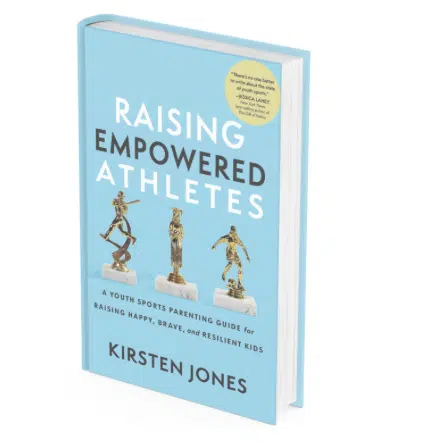
Kirsten is a Hall of Fame NCAA Division I volleyball player, a 15-year NIKE executive, a motivational speaker, peak performance coach and the author of Raising Empowered Athletes: A Youth Sports Parenting Guide for Raising Happy, Brave and Resilient Kids.
As a coach, she works with athletes, parents and sports organization leaders, where she helps them learn how to reach their goals by releasing their limitations. Kirsten’s superpower is helping people get out of their heads and into their bodies so they can feel their best and perform beyond what even they dreamed possible.
She is the host of the RaisingAthletes Podcast, where she interviews coaches, athletes, trainers and industry experts about everything youth sports.
Kirsten and her husband, Evan, have loved raising three young adult athletes (ages 24, 21, and 19) in Los Angeles.
Please sign up receive updates, hear the podcast or schedule a call at kirstenjonesinc.com or https://kirstenjones.substack.com/
@kirstenjonesinc (Facebook and X)
@kirstenjonescoach (Instagram and LinkedIn)